Address
304 North Cardinal
St. Dorchester Center, MA 02124
Work Hours
Monday to Friday: 7AM - 7PM
Weekend: 10AM - 5PM
Address
304 North Cardinal
St. Dorchester Center, MA 02124
Work Hours
Monday to Friday: 7AM - 7PM
Weekend: 10AM - 5PM
A custom exhaust pipe manufacturer in China can look qualified on a quotation sheet while still creating fitment errors, uneven batches, delayed shipments, or unexpected tooling charges. I have seen buyers focus on the lowest unit price, then face difficult questions after production begins. A better approach is to verify how a supplier understands, samples, controls, and delivers a custom program.
A reliable custom exhaust pipe manufacturer in China should demonstrate more than catalog inventory or a fast quotation. Buyers should verify the supplier’s requirement-review process, tooling plan, first-article approval method, in-process inspection, batch traceability, packaging standards, and change-control practices. I recommend using a documented sample approval and a small pilot order before committing to large-volume purchasing.
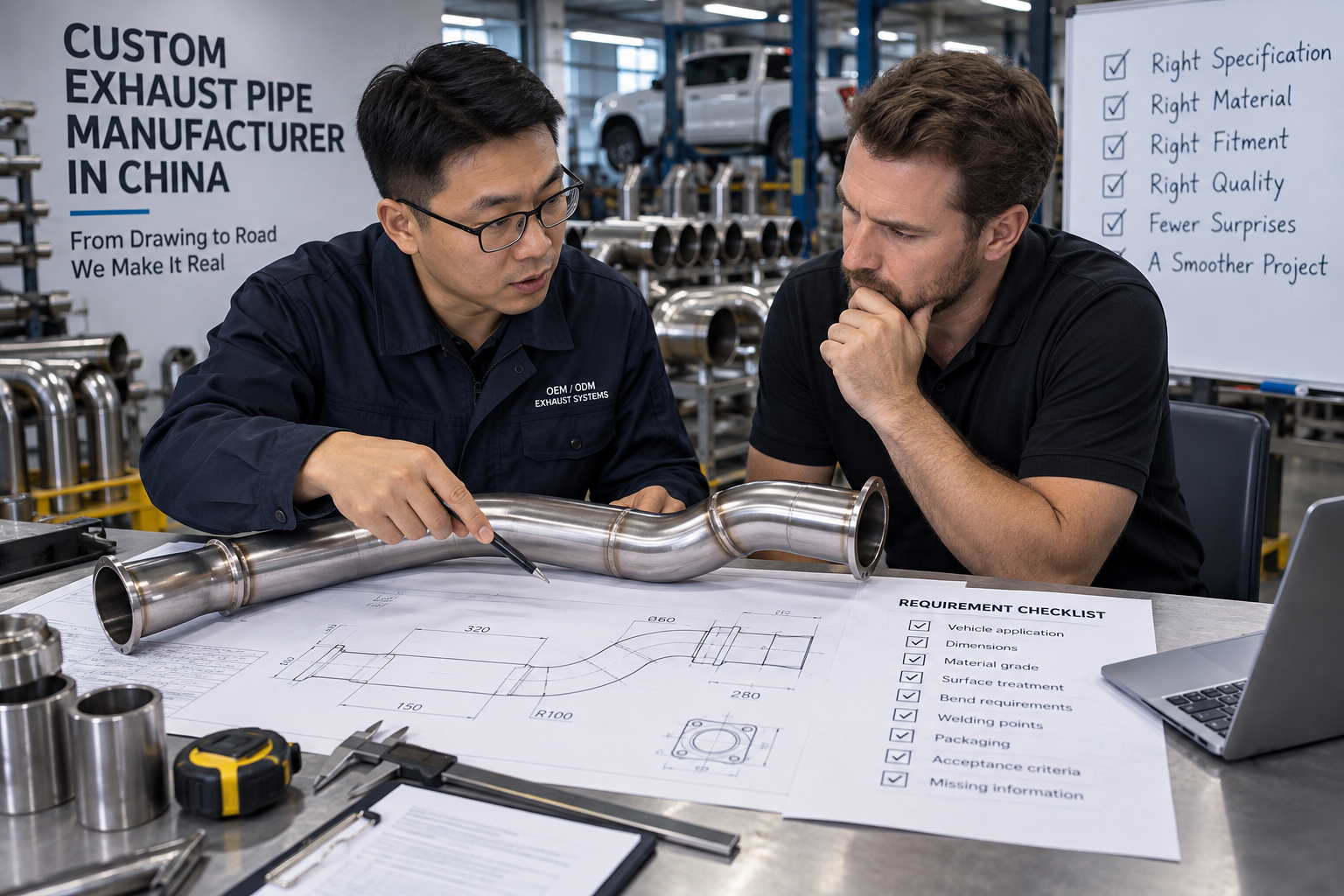
Choosing a supplier is not simply a sourcing task. It is a procurement risk-control decision.1 Below, I explain the practical questions I would ask before selecting a factory for automotive, pickup truck, or heavy-duty truck exhaust pipe programs.
A quotation can arrive quickly, but speed does not prove that the supplier understands your exhaust pipe application. If the drawing is incomplete, the vehicle fitment is unclear, or the material grade is missing, a low quote may be based on assumptions.2 Those assumptions can become rework, claims, and delayed inventory later.
A buyer should test a custom exhaust pipe manufacturer in China by asking the supplier to restate the full requirement in writing before requesting a final quotation. I would expect the supplier to identify the vehicle application, dimensions, material, surface treatment, bend requirements, welding points, packaging, acceptance criteria, and any missing information that affects production.
I usually encourage buyers to send a controlled inquiry package rather than only a photo and a target price. A capable supplier should not simply reply, “We can make it.” Instead, the supplier should confirm what it believes it is being asked to produce.
For example, I would ask a supplier to restate:
This exercise matters because a supplier may have a similar catalog item without having the same manufacturing capability. A factory may produce a general-purpose universal exhaust tube but lack the tooling, fixtures, or process controls needed for a vehicle-specific replacement pipe.
I have seen inquiries where a buyer supplied only several photos and a rough length. In those situations, the most important signal was not the initial quote. It was whether the supplier asked clear follow-up questions before making commitments.
A useful supplier will identify uncertainty. This behavior should not be treated as a delay tactic. It can be a sign that the supplier understands the difference between an estimate and a controlled production instruction.
Common missing details include:
| Missing Detail | Why It Creates Procurement Risk | Verification Action |
|---|---|---|
| Vehicle fitment range | A pipe may fit one engine or wheelbase but not another | Request a written fitment statement and sample-fitment plan |
| Tube wall thickness | Small changes can affect durability, weight, cost, and bend behavior3 | Require thickness tolerance in the drawing or purchase order |
| Material grade | Similar-looking materials may perform differently in service | Ask for the proposed material specification and supplier documentation |
| Hanger position | Incorrect placement can create installation difficulty | Compare sample dimensions with a controlled drawing or master sample |
| Packaging standard | Poor packaging can damage flanges, coatings, and pipe ends | Request packaging photos and a carton specification |
| Acceptance criteria | “Good quality” is not measurable | Define dimensional, visual, weld, and packaging acceptance points |
I would not compare quotations until each supplier has quoted the same requirement. If one factory assumes thinner material, no fixture cost, standard packaging, and loose dimensional tolerance, its price may look lower for reasons that do not appear on the quotation.
A better comparison asks each supplier to separate:
This gives me a clearer view of the real purchasing decision. It also helps buyers identify hidden cost risks before they become disputes.
Many suppliers can show product photos, reference numbers, and existing exhaust pipe listings. However, catalog availability does not automatically mean that the supplier can build a new pipe, revise an existing design, or maintain repeatable production across multiple batches.4 Buyers should examine the workflow behind the product, not only the product page.
A custom exhaust pipe manufacturer in China should be able to explain how a request moves from drawing review to tooling, sample production, first-article approval, mass production, inspection, packaging, and shipment. I would look for documented handoffs and clear responsibility at each stage, especially when the program includes vehicle-specific fitment requirements.
I do not expect every supplier to own every process. Some suppliers may outsource coating, stamping, or certain specialized components. Outsourcing itself is not necessarily a problem.5 The important question is whether the supplier controls the process and can explain how it verifies externally sourced parts.
A practical workflow review should cover the following stages.
The factory should confirm the latest drawing revision, material callouts, tolerance points, and special features. If a buyer provides a physical sample, the parties should clarify whether that sample is only a visual reference or the final master standard.
Custom exhaust pipes often require fixtures for bending, welding, bracket placement, or flange orientation.6 I would ask:
Tooling ownership and maintenance should appear in the commercial agreement. Verbal expectations can easily cause confusion after a program changes.
The first article is the bridge between design intent and production reality.7 Buyers should not approve a sample only because it “looks right” in a photograph.
I recommend checking the sample against agreed criteria such as:
A manufacturer can provide measurements, but application-specific fitment and performance decisions should be evaluated by qualified personnel. I would not treat a general factory statement as a substitute for your own technical validation.
Final inspection can catch visible defects, but it may not prevent a process from drifting during a production run.8 I would ask how the supplier checks critical points during production.
For example, a supplier may use:
The specific inspection method should match the product risk. A simple universal connector pipe may need fewer controls than a vehicle-specific exhaust assembly with multiple brackets, flanges, and sensor ports.
Batch traceability helps buyers investigate problems without guessing which shipment or production period caused the issue.9 I would ask whether the supplier can link a finished batch to production date, material lot, work order, inspector, and packaging lot.
I would also ask what happens when a change is requested. A controlled process should include:
Without change control, a buyer may receive mixed versions of a part.10 That risk can be especially costly for wholesalers and retailers managing catalog data, returns, and multiple warehouse locations.
An approved sample is valuable, but it is not enough on its own. A single sample can be produced with extra attention, while later batches may vary if the process is not controlled. Certificates can also be useful, but buyers should verify what the document actually covers rather than assuming it applies to every product or market.
Buyers should verify a custom exhaust pipe manufacturer in China by linking documents, samples, and production batches to the same written acceptance criteria. I recommend checking certificate holders, scope, validity dates, and applicable product categories, then confirming that the supplier can maintain the approved sample’s critical features during normal production.
A sample approval should create a clear record. I would document the approved sample with photos, part number, revision number, approval date, measurements, and agreed deviations if any exist.
The buyer and supplier should agree on questions such as:
This level of detail may seem formal for a pipe assembly. However, it becomes important when a buyer needs to reorder six months later and expects the same installation geometry, packaging, and finish.
I do not present myself as a certification body or regulatory authority. Still, I believe buyers should independently verify any certification or compliance document that influences a sourcing decision.
A buyer can check:
| Document Review Point | What to Verify |
|---|---|
| Certificate holder | Confirm the legal company name matches the supplier or stated production site |
| Scope | Check whether the scope covers the relevant management system, facility, process, or product category |
| Validity | Review issue date, expiry date, and current status |
| Issuing body | Confirm the issuer and available verification route |
| Product relevance | Do not assume a general document proves compliance for a specific exhaust pipe |
| Market applicability | Verify destination-market requirements with qualified professionals or relevant authorities |
A management-system certificate is not the same as product approval.11 Likewise, a material report does not automatically prove that the final assembled exhaust pipe meets every application requirement. Buyers should separate these concepts during supplier evaluation.
I recommend attaching an inspection plan to the purchase order or quality agreement. The plan should define what will be checked, how often it will be checked, and what happens if results fall outside the agreed range.
A basic plan might include:
| Inspection Area | Example Verification Method | Timing |
|---|---|---|
| Tube material | Review agreed material documentation | Incoming material |
| Outside diameter | Caliper, gauge, or suitable measuring tool | First piece and in-process |
| Wall thickness | Agreed measurement method | Incoming and/or sample check |
| Overall geometry | Fixture or dimensional reference | First piece and periodic checks |
| Weld condition | Visual standard and agreed criteria | In-process and final inspection |
| Bracket location | Fixture check or dimension measurement | First piece and periodic checks |
| Packaging | Carton count, protection, labels | Final packing stage |
The buyer should define acceptance criteria before production begins. If the requirement is only “no defect,” both sides may interpret quality differently.
A third-party inspection can provide an additional observation point before shipment. However, an inspection company can only inspect against an agreed standard. It cannot solve an unclear drawing, vague fitment requirement, or undefined packaging expectation.
I would use third-party inspection as one layer in the system, not as the entire quality strategy. The strongest control remains a clear specification, approved first article, controlled production process, and documented corrective action if issues occur.
Large orders can reduce unit cost, but they also increase the financial impact of a supplier mistake. A pilot order gives buyers a controlled way to evaluate whether a supplier can repeat an approved sample under normal production conditions.12 It also reveals how the supplier communicates when real delivery pressure begins.
A pilot order from a custom exhaust pipe manufacturer in China should test total procurement performance rather than only product appearance. I would evaluate batch consistency, lead-time accuracy, packaging protection, documentation, communication speed, issue handling, and the supplier’s willingness to follow the agreed approval process before expanding the program.
A pilot order should have specific evaluation goals. It does not need to be large, but it should be large enough to show whether production is repeatable beyond one hand-finished sample.
I recommend that buyers define pilot-order success criteria before placing the order. These may include:
For wholesalers and large retailers, packaging deserves special attention. A well-made exhaust pipe can still become a return if brackets are bent during transit, labels do not match the catalog, or cartons cannot withstand normal warehouse handling.
The lowest factory price may not be the lowest landed risk. I would compare suppliers using a broader scorecard.
| Evaluation Area | Questions I Would Ask | Evidence to Request |
|---|---|---|
| Requirement understanding | Did the supplier identify missing specifications? | Written requirement restatement |
| Sample control | Was the first article measured and documented? | Sample report, photos, approval record |
| Production consistency | Can the supplier explain in-process checks? | Inspection plan, process flow |
| Lead-time reliability | Did the supplier meet realistic milestones? | Pilot-order timeline and shipment records |
| Communication | Did the supplier answer technical questions clearly? | Email trail, meeting notes |
| Packaging | Did the goods arrive protected and correctly labeled? | Packaging specification and pilot photos |
| Problem handling | Did the supplier investigate issues with evidence? | Corrective-action response |
| Commercial clarity | Were tooling, packaging, and other charges transparent? | Detailed quotation and order terms |
This method helps a buyer avoid a common sourcing trap: selecting a supplier based on an attractive first quote, then discovering later that the quoted scope excluded necessary fixtures, upgraded packaging, or inspection requirements.
No supplier can guarantee that every production process will never have an issue. I focus on how the supplier responds when a problem is identified.
A constructive response should include:
I would be cautious when a supplier immediately blames shipping, the drawing, or the buyer without reviewing evidence. I would also be cautious when a supplier promises a correction but provides no revised inspection point or process change.
After a successful pilot, I prefer a staged scale-up rather than an immediate jump to the largest possible order. A buyer can increase volume while reviewing each shipment’s quality, delivery performance, and claim rate.
This staged approach is especially useful when introducing a new vehicle application, a new material choice, a new coating process, or a revised package design. It gives both parties time to stabilize the process before inventory exposure becomes too large.
I recommend sending a controlled inquiry package with drawings, reference numbers, vehicle fitment details, material requirements, dimensions, photos, expected order volume, packaging needs, labels, and acceptance criteria. If information is missing, I would ask the supplier to identify the gaps in writing before final quotation.
No. The cheapest quote may be based on different materials, thinner walls, loose tolerances, basic packaging, excluded tooling, or unconfirmed fitment assumptions. I recommend comparing total procurement risk, including sample control, communication, lead time, packaging, inspection, and corrective-action capability.
Buyers should check the certificate holder, issuing organization, scope, validity period, and relevance to the product or process being purchased. A certificate should not be treated as automatic proof of product compliance. Market-specific requirements should be independently verified with qualified professionals.
Yes. I recommend approving a documented first article before mass production. The approval should cover critical dimensions, bracket positions, welding, finish, packaging, and relevant fitment checks. Buyers should also confirm how production batches will be kept consistent with the approved sample.
A pilot order should evaluate more than the parts themselves. I would review production consistency, documentation, packaging, carton labels, shipment timing, communication, and problem handling. A pilot order gives buyers practical evidence before they expose their inventory budget to larger purchase volumes.
Choosing a custom exhaust pipe manufacturer in China requires more than comparing unit prices and reviewing product photos. I recommend testing how each supplier interprets requirements, controls tooling and samples, verifies production quality, manages changes, and handles pilot-order performance. Certificates and approved samples can support a decision, but buyers should verify their scope and connection to actual production. If you are building an exhaust, intake pipe, muffler, or general tube-fitting program, I encourage you to prepare a clear specification package and use it to evaluate suppliers with evidence before scaling up.
"[PDF] Managing risks in the public procurement of goods, services ... - OECD", https://www.oecd.org/content/dam/oecd/en/publications/reports/2023/06/managing-risks-in-the-public-procurement-of-goods-services-and-infrastructure_b0d29f96/45667d2f-en.pdf. International procurement and risk-management frameworks characterize supplier selection as an assessment of operational, commercial, quality, and delivery risks in addition to price. Evidence role: general_support; source type: institution. Supports: Established risk-management and procurement frameworks treat supplier selection as a process involving the identification, assessment, and control of risks, not price alone.. Scope note: Such frameworks support the general procurement principle but do not specifically evaluate Chinese exhaust-pipe manufacturers. ↩
"[PDF] Requirements analysis: process plan specification - workstation level", https://nvlpubs.nist.gov/nistpubs/Legacy/IR/nistir6172.pdf. ISO 9001 requires organizations to review applicable customer and product requirements and resolve requirements that differ from those previously expressed before accepting a commitment to supply. Evidence role: mechanism; source type: institution. Supports: Quality-management standards require organizations to review customer requirements, resolve differences, and confirm requirements before committing to supply.. ↩
"[PDF] Finite element bending analysis of oval tubes using rotary draw ...", https://wpfiles.mines.edu/wp-content/uploads/aspprc/ResearchMaterials/Publications/270-Lee.pdf. Experimental and numerical studies of tube bending identify wall thickness as a material and geometry parameter affecting thinning, wrinkling, ovalization, and forming limits; thickness also directly influences tube mass and material consumption. Evidence role: mechanism; source type: paper. Supports: Tube-bending research shows that wall thickness influences thinning, wrinkling, ovalization, and forming limits, while elementary structural relationships connect thickness with mass and load capacity.. Scope note: These relationships are general engineering effects; their practical significance for a particular exhaust pipe depends on its material, geometry, loading, and manufacturing process. ↩
"Supply Chain Management - NIST", https://www.nist.gov/mep/supply-chain. Government and quality-management guidance on supplier evaluation treats technical capability, process control, capacity, and past performance as distinct evidence that must be assessed rather than inferred from a product listing. Evidence role: general_support; source type: government. Supports: Supplier-assessment guidance evaluates technical capability, quality systems, capacity, and past performance separately from the mere availability of products.. Scope note: The guidance establishes a general supplier-evaluation principle and does not prove that any particular catalog supplier lacks manufacturing capability. ↩
"[PDF] Cisco® Managing Supply Chain Risks End-to-End - NIST", https://www.nist.gov/document/nistusrp-cisco-cyber-scrm-case-studypdf. ISO 9001 recognizes the use of externally provided processes, products, and services but requires the organization to determine and apply controls sufficient to ensure conformity with specified requirements. Evidence role: expert_consensus; source type: institution. Supports: Quality-management standards permit externally provided processes while requiring the purchasing organization to define and apply appropriate controls.. ↩
"[PDF] Unilateral Fixtures for Sheet Metal Parts with Holes", https://gab.wallawalla.edu/~ralph.stirling/classes/engr480/docs/Assembly/orientingparts_IEEE-Unilateral-Fixturing-15-Dec-2003.pdf. Manufacturing-engineering literature describes fixtures as devices that locate, support, and constrain workpieces to maintain repeatable geometry during operations such as bending, welding, and assembly. Evidence role: mechanism; source type: education. Supports: Manufacturing-engineering references explain that jigs and fixtures locate, support, and constrain workpieces so that geometry and feature positions can be reproduced during forming and joining.. Scope note: The need for a dedicated fixture depends on the pipe's complexity, tolerances, production volume, and process design. ↩
"[PDF] Printable Format (PDF) - NASA Procedural Requirements", https://nodis3.gsfc.nasa.gov/displayDir.cfm?Internal_ID=N_PR_8735_002C_&page_name=Chapter4&format=PDF. Formal first-article inspection guidance defines the process as an examination of an initial production item to determine whether prescribed materials, tooling, processes, and documentation have produced an article conforming to engineering requirements. Evidence role: definition; source type: government. Supports: Formal first-article inspection guidance defines the activity as verification that prescribed production methods have produced an item conforming to engineering requirements.. Scope note: Many formal first-article frameworks originate in aerospace or government procurement, so their detailed documentation requirements may exceed those appropriate for an automotive exhaust-pipe order. ↩
"[PDF] End-to-End Quality Information Framework (QIF) Technology Survey", https://nvlpubs.nist.gov/nistpubs/ir/2016/NIST.IR.8127.pdf. NIST guidance on statistical process control explains that control charts and in-process measurements are used to detect changes in process location or variability over time, whereas final inspection primarily classifies completed output. Evidence role: mechanism; source type: government. Supports: Statistical process-control references explain that monitoring measurements over time can identify changes in process location or variability that final product inspection alone may not prevent.. ↩
"FSMA Final Rule on Requirements for Additional Traceability Records", https://www.fda.gov/food/food-safety-modernization-act-fsma/fsma-final-rule-requirements-additional-traceability-records-certain-foods. Traceability standards and recall guidance describe lot and production records as mechanisms for reconstructing a product's history and identifying the population potentially affected by a quality or safety issue. Evidence role: mechanism; source type: institution. Supports: Traceability systems connect products with production, material, and distribution records, enabling investigators to identify potentially affected lots and limit the scope of containment or recall.. Scope note: Traceability facilitates investigation and containment but does not, by itself, establish the root cause of a defect. ↩
"[PDF] ENGINEERING DRAWING STANDARDS MANUAL - S3VI", https://s3vi.ndc.nasa.gov/ssri-kb/static/resources/NASA%20GSFC-X-673-64-1F.pdf. Configuration-management guidance links formal change identification, approval, implementation, and status accounting with maintaining a known product baseline and preventing unintended configuration discrepancies. Evidence role: mechanism; source type: government. Supports: Configuration-management guidance requires changes to be identified, evaluated, approved, implemented, and recorded so that the applicable product configuration remains known.. Scope note: The guidance establishes the mechanism by which version mixing is controlled, but it does not quantify how often mixed revisions occur in exhaust-pipe supply chains. ↩
"Certification - ISO", https://www.iso.org/certification.html. Standards and accreditation bodies distinguish management-system certification, which assesses an organization's management arrangements within a stated scope, from product certification, which evaluates a specified product against defined requirements. Evidence role: definition; source type: institution. Supports: Accreditation and standards bodies distinguish certification of a management system from certification or approval of a particular product.. ↩
"Food Industry Services | College of Agricultural Sciences", https://foodsci.oregonstate.edu/foodsci/food-industry-services. Manufacturing ramp-up research describes pilot production as an intermediate stage in which process repeatability, quality controls, material flow, and operational readiness can be evaluated before committing to full-scale production. Evidence role: general_support; source type: research. Supports: Research on pilot production and manufacturing ramp-up describes limited production runs as opportunities to test process capability, repeatability, material flow, quality controls, and operational readiness before full-scale output.. Scope note: A successful pilot reduces uncertainty but cannot guarantee identical performance at substantially higher volumes or after later changes to materials, tooling, personnel, or processes. ↩